Watching Linux tutorials and memorizing commands can help you learn the basics. But how do you know if you are ready for the CompTIA Linux+ XK0-006 exam?
To assess your XK0-006 exam readiness (exam prep materials:https://www.leads4pass.com/xk0-006.html), you need both practice questions and hands-on experience.
This article will help you test your Linux skills, find gaps in your knowledge, and decide what to review before exam day. It also includes a dedicated place for 30 updated free XK0-006 practice questions.
What Does XK0-006 Readiness Actually Look Like?
CompTIA Linux+ V8 uses exam code XK0-006. The exam allows up to 90 questions and has a 90-minute time limit. It includes multiple-choice and performance-based questions (PBQs), which test how well you can apply your knowledge to practical tasks.
According to the published exam objectives, the five domains and their weightings are:
| Official exam domain | Exam weighting |
| System Management | 23% |
| Services and User Management | 20% |
| Security | 18% |
| Automation, Orchestration, and Scripting | 17% |
| Troubleshooting | 22% |
These percentages can help you plan your review. However, they do not tell you exactly which questions will appear on your exam. Check the latest official CompTIA Linux+ certification page before exam day to confirm the current requirements.
Your readiness depends on three practical skills.
First, you can choose the right tool. When something goes wrong, you know which command can help you investigate it.
Second, you can understand the output. You do not simply run a command and hope for the best. You use its results to decide what to do next.
Third, you can verify the result. After making a change, you check whether the original problem is fixed and whether the solution meets the requirements.
If you struggle with any of these steps, you have a clear starting point for further practice.
Free XK0-006 Practice Questions: Test Your Knowledge
Hands-on exercises help you apply Linux commands, but practice questions serve a different purpose. They help you check your understanding of technical concepts, identify weak areas, and become familiar with exam-style scenarios.
The following section contains 30 updated free XK0-006 practice questions. Work through all 30 questions before checking your results. For each incorrect answer, identify the concept you misunderstood and review the relevant part of the official exam objectives.
Do not focus only on your score. Pay attention to questions you answered by guessing, too. A correct guess does not necessarily mean you understand the topic well enough to apply it in a different situation.
Question 1
Single choice
Which of the following commands should an administrator use to see a full hardware inventory of a Linux system?
A.dmidecode
B.lsmod
C.dmesg
D.lscpu
Question 2
Single choice
A Linux administrator is configuring a CUPS print service on a Linux machine and needs to allow only connections from a local network (192.168.100.0/24).
Which of the following commands should the administrator use?
A.iptables -A OUTPUT -d 192.168.100.0/24 –sport 631 -p tcp -j ACCEPT
B.iptables -A OUTPUT -s 192.168.100.0/24 –dport 631 -p tcp -j ACCEPT
C.iptables -A INPUT -s 192.168.100.0/24 –dport 631 -p tcp -j ACCEPT
D.iptables -D INPUT -d 192.168.100.0/24 –dport 631 -p tcp -j ACCEPT
Question 3
Single choice
A systems administrator receives a report about performance issues in a Linux production system.
Which of the following commands should the administrator use to help diagnose the performance issues?
A.jobs
B.renice
C.top
D.pkill
Question 4
Single choice
A DevOps engineer needs to create a local Git repository.
Which of the following commands should the engineer use?
A.git init
B.git clone
C.git config
D.git add
Question 5
Single choice
Which of the following is a way to enable a production web server’s communications with strong encryption and identity verification?
A.Creating a key pair using ssh-keygen and using the generated key pair to secure the HTTPS communication
B.Creating a private key locally using openssl, creating a certificate request, sending the request to an external certification provider, and using the provided certificate for HTTPS communication
C.Creating a 4096-bytes or longer self-signed certificate using openssl and using it to secure HTTPS communication
D.Creating a secret file using /dev/random as a source and using the generated file for HTTPS communication
Question 6
Single choice
A systems administrator is configuring new Linux systems and needs to enable passwordless authentication between two of the servers.
Which of the following commands should the administrator use?
A.ssh-keygen -t rsa && ssh-copy-id -i ~/.ssh/id_rsa.pub john@server2
B.ssh-keyscan -t rsa && ssh-copy-id john@server2 -i ~/.ssh/key
C.ssh-agent -i rsa && ssh-copy-id ~/.ssh/key john@server2
D.ssh-add -t rsa && scp -rp ~/.ssh john@server2
Question 7
Single choice
An administrator needs to install an Apache web server on an Ubuntu server.
Which of the following commands should the administrator use?
A.zypper install apache
B.apt install apache2
C.yum install httpd
D.rpm -i apache.deb
Question 8
Single choice
A systems administrator wants to leverage their password-protected SSH key to connect to multiple servers without entering their password every time.
Which of the following commands should the administrator use?
A.ssh-copy-id
B.ssh-agent
C.ssh-add
D.ssh-keygen
Question 9
Single choice
Which of the following utilities can securely delete a Linux directory from a filesystem and ensure it cannot be recovered?
A.dd
B.shred
C.unlink
D.rm
Question 10
Single choice
During a security scan, the passphrase protecting an SSH private key file was found to be too weak.
Which of the following commands would allow a user to choose a stronger passphrase and set it on the existing SSH private key file?
A.passwd
B.ssh
C.ssh-keygen -p
D.pwgen
Question 11
Single choice
A Linux administrator intends to start using KVM on a Linux server.
Which of the following commands will allow the administrator to load the KVM module as well as any related dependencies?
A.modprobe kvm
B.insmod kvm
C.depmod kvm
D.hotplug kvm
Question 12
Single choice
An administrator receives the following output while attempting to unmount a filesystem:
umount /data1: target is busy.
Which of the following commands should the administrator run next to determine why the filesystem is busy?
A.ps -f /data1
B.du -sh /data1
C.top -d /data1
D.lsof | grep /data1
Question 13
Single choice
A systems administrator is preparing a Linux system for application setup. The administrator needs to create an environment variable with a persistent value in one of the user accounts.
Which of the following commands should the administrator use for this task?
A.export “VAR=SomeValue” >> ~/.ssh/profile
B.export VAR=value
C.VAR=value
D.echo “export VAR=value” >> ~/.bashrc
Question 14
Single choice
Which of the following best describes journald?
A.A system service that collects and stores logging data
B.A feature that creates crash dumps in case of kernel failure
C.A service responsible for keeping the filesystem journal
D.A service responsible for writing audit records to a disk
Question 15
Single choice
Users report that they are unable to reach the company website https://www.comptia.org. A systems administrator confirms the issue with the following command:
# curl https://www.comptia.org
curl: (7) Failed to connect to www.comptia.org port 443: No route to host
The administrator logs in to the company’s web server to check its configuration and sees the following output:
[email protected]:-># firewall-cmd –list-all
public (active)
target: default
icmp-block-inversion: no
interfaces: dummy0 eth0
sources:
services: cockpit dhcpv6-client http ssh
ports: 3001/tcp
protocols:
forward: no
masquerade: no
forward-ports:
source-ports:
icmp-blocks:
rich rules:
rule family=”ipv4″ source address=”61.177.173.6″ port port=”ssh” protocol=”tcp” reject type=”icmp-port-unreachable”
rule family=”ipv4″ source address=”185.143.45.164″ port port=”ssh” protocol=”tcp” reject type=”icmp-port-unreachable”
rule family=”ipv4″ source address=”143.198.60.41″ port port=”ssh” protocol=”tcp” reject type=”icmp-port-unreachable”
[email protected]:-># ip route
default via 172.31.1.1 dev eth0 proto dhcp src 65.21.187.65 metric 100
10.0.6.0/24 dev dummy0 proto kernel scope link src 10.0.6.65 metric 550
172.17.0.0/16 dev docker0 proto kernel scope link src 172.17.0.1
172.18.0.0/16 dev br-28ac2eaeeca1 proto kernel scope link src 172.18.0.1
172.19.0.0/16 dev br-fb3897555ca3 proto kernel scope link src 172.19.0.1 linkdown 172.31.1.1 dev eth0
proto dhcp scope link src 65.21.187.65 metric 100
192.168.224.0/20 dev br-e949ab177d79 proto kernel scope link src 192.168.224.1 linkdown
192.168.240.0/20 dev br-6adf72ac0ae3 proto kernel scope link src 192.168.240.1 linkdown
Which of the following is causing the issue?
A.The web server’s interface has no link.
B.The default route on the web server is incorrect.
C.HTTPS traffic is not allowed through the web server firewall.
D.User IP addresses are rejected by the firewall.
Question 16
Single choice
A small group of remote users needs permission to run some administrative commands on a Linux server.
Which of the following approaches is the best way to address this request?
A.Set the sticky bit in all binaries requested for use by this group of users.
B.Request a list of utilities they need to use with elevated privileges, and add the appropriate rules.
C.Set the configuration parameter PermitRootLogin on sshd_config to ” yes ” and share the root password with this group of users.
D.Create a Linux group, add the users, and configure this group on /etc/sudoers to use sudo, thus allowing them to switch to root user.
Question 17
Single choice
An application requires a configuration file be placed in each user’s home directory when an account is created.
In which of the following locations should the administrator place the configuration file?
A./etc/ske1
B./etc/sysconfig
C./etc/ssh
D./etc/rc.local
Question 18
Single choice
A Linux administrator was notified that a virtual server has an I/O bottleneck. The Linux administrator analyzes the following output:
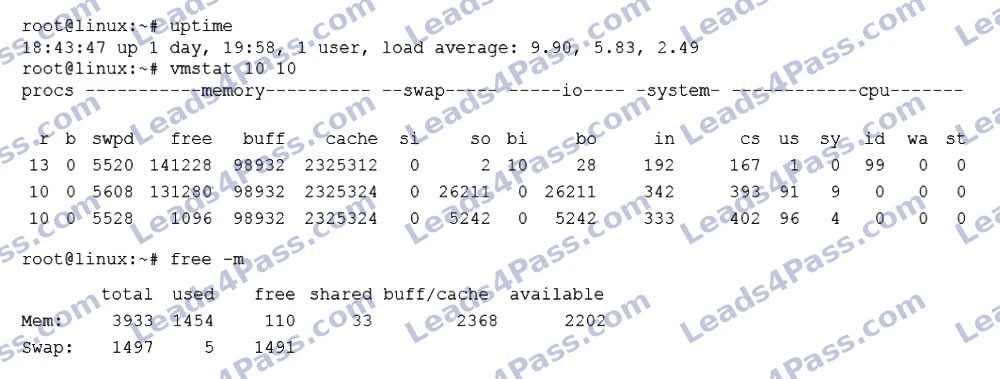
Given that there is a single CPU in the server, which of the following is the most likely cause of the slowness?
A.The system is running out of swap space.
B.The CPU is overloaded.
C.The memory is exhausted.
D.The processes are paging.
Question 19
Single choice
Which of the following statements best describes Ansible?
A.A tool used for monitoring cloud infrastructure
B.A software configuration tool with its own declarative, Ruby-based language
C.A CI/CD tool that allows automation using pipelines
D.A tool that provides automation using playbooks written in YAML
Question 20
Single choice
Which of the following options represents disk mirroring?
A.RAID 0
B.RAID 1
C.RAID 5
D.RAID 6
Question 21
Multiple choice
Users connecting to a MySQL database on a Linux system report frequent errors. An administrator reviews the following partial output of the /proc/meminfo and free commands:
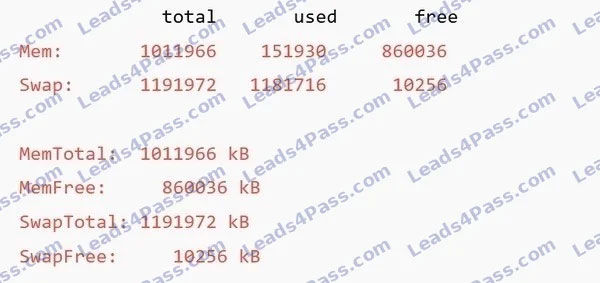
Which of the following should the administrator do to ensure that the MySQL service will continue to run even if the system runs out of swap space? (Select two.)
A.Issue the sysctl -w vm.overcommit_ratio=100 command.
B.Issue the sysctl -w vm.overcommit_memory=2 command.
C.Issue the dd if=/dev/zero of=/swapfile bs=1024 count=65536 command.
D.Issue the mkswap /dev/sda2; swapon -v /dev/sda2 command.
E.Reload the /etc/fstab file by issuing the mount -a command.
F.Use disk quotas on the swap space to prevent MySQL from overutilizing the swap partition.
Question 22
Single choice
A user sends a request to access a virtual server via SSH.
Which of the following commands is used to open the SSH standard port?
A.firewalld-cmd –permanent –add-port=22/tcp
B.iptables-save | grep dport-22/tcp
C.iptables -A INPUT -p tcp –dport sshd -j ACCEPT
D.firewalld-cmd –remove-service=ssh –permanent
Question 23
Single choice
An administrator attempts to install updates on a Linux system but receives error messages regarding a specific repository.
Which of the following commands should the administrator use to verify that the repository is installed and enabled?
A.yum repo-pkgs
B.yum list installed repos
C.yum reposync available
D.yum repolist all
Question 24
Multiple choice
An administrator must secure an account for a user who is going on extended leave.
Which of the following steps should the administrator take? (Choose two)
A.Set the user’s files to immutable.
B.Instruct the user to log in once per week.
C.Delete the user’s /home folder.
D.Run the command passwd -l user.
E.Change the date on the /home folder to that of the expected return date.
F.Change the user’s shell to /sbin/nologin.
Question 25
Single choice
An administrator set up a new user account called “test”. However, the user is unable to change their password. Given the following output:
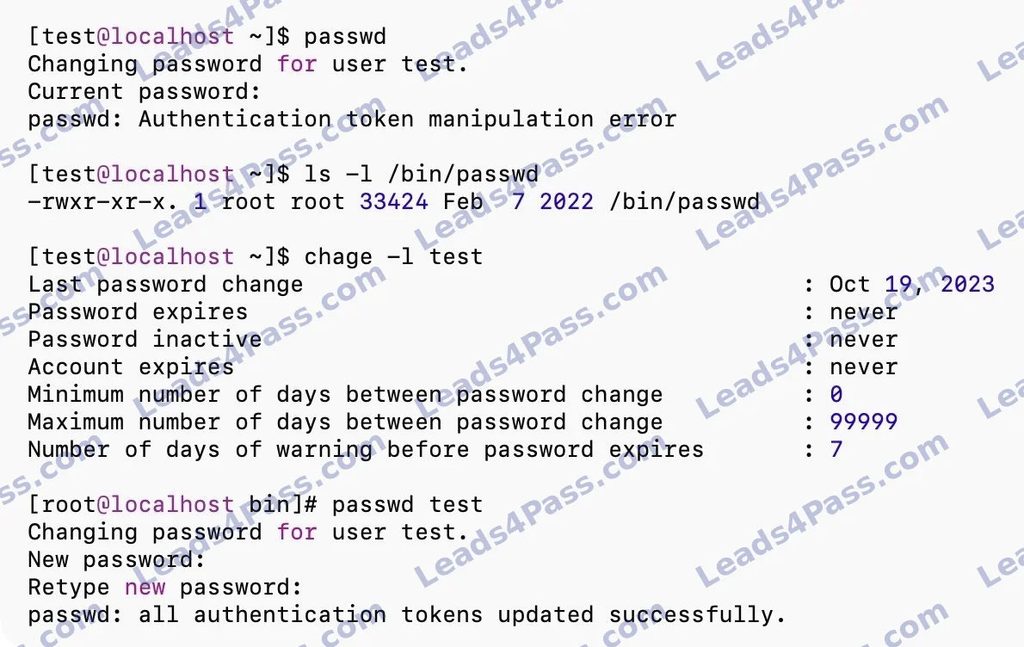
Which of the following is the most likely cause of this issue?
A.The SUID bit is missing on the /bin/passwd file.
B.The password provided by the user “test” does not meet complexity requirements.
C.The user “test” already changed the password today.
D.The password has been disabled for user “test”.
Question 26
Single choice
An administrator wants to start an Ubuntu terminal in a container.
Which of the following will allow the administrator to complete the task?
A.podman pull ubuntu /bin/bash
B.docker run -it ubuntu
C.containerd /usr/bin/sh ubuntu
D.runc exec -it ubuntu
Question 27
Single choice
Which of the following is the first step when starting a new Python project on a Linux system?
A.python -m venv /path/to/project
B.python -m pip install -r /path/to/project
C.export PYTHON_PATH=/path/to/project
D.python -m source /path/to/project
Question 28
Single choice
A systems administrator is working on an SFTP server configuration.
Which of the following commands will best enable the connectivity to that service from the 10.10.0.0/24 network?
A.sudo ufw allow from 10.10.0.0/24 to any port 22
B.sudo ufw allow in on eth0 to any port 22
C.sudo ufw allow from 10.10.0.0/24
D.sudo ufw allow 0:22/tcp from 10.10.0.0
Question 29
Single choice
Which of the following commands can be used to display real-time running processes on a Linux system?
A.ps
B.top
C.df
D.free
Question 30
Single choice
Which of the following is the best use of AI within a Linux environment?
A.Giving full control of the Linux server to the AI engine
B.Uploading company internal messaging for user validation
C.Outsourcing proprietary source code development to the LLM
D.Generating an nginx configuration file that can be used for testing
…
After completing these 30 questions, verify the correct answers at https://www.leads4pass.com/xk0-006/questions.html, then go through each question you answered incorrectly. Reflect on the cause: Did you misunderstand the instructions, overlook a key detail in the scenario, or perhaps lack knowledge of a specific Linux feature? Afterward, revisit the relevant exam objectives; if a skill involves hands-on tasks, make sure to practice it.
For example, if you consistently get questions about systemd wrong, review service states and clarify the distinction between “enabling” and “starting” a service. If you struggle with questions regarding permissions, practice checking ownership, directory access rights, and Access Control Lists (ACLs). If networking-related questions prove difficult, use a Linux lab environment to explore topics such as IP addressing, routing, name resolution, and listening ports.
This approach transforms your practice results into a concrete, actionable study plan, ensuring you aren’t left wondering what to do next after seeing your score.
How to Practice PBQs Without Memorizing Answers
Performance-based questions test whether you can apply your knowledge to a task. You may need to configure a system, change a setting, or complete several steps to meet a requirement.
The best way to prepare is to practise the skills themselves. A Linux virtual machine is enough for many tasks involving files, users, services, shell scripts, and network configuration. Some exercises require a fuller environment, especially when they involve boot settings, kernel behavior, or host-level networking.
Choose one exam objective and create a task with a clear goal. Before running commands, identify the starting state and the required result. Then complete the task without following a step-by-step tutorial.
For example, create a user account with specific group membership, configure a scheduled task, or write a shell script that processes files. Check your work after each important step. If a command fails, read the error message and investigate the cause instead of repeating the command without changes.
Once the task works, change one requirement and try again. You might need to use a different account, handle a missing file, or make a setting persistent. This helps you understand the process.
Always verify the final result. Check the relevant configuration, inspect exit codes, and confirm that the change meets the original requirement. If persistence matters, check whether the configuration survives a service restart or system reboot.
What Should You Review Before Exam Day?
Your final review should focus on the areas where you still make mistakes. Reading every note again may feel productive, but it does not always address the skills you find difficult.
Start with the official XK0-006 exam objectives. Mark the topics you understand well, the ones you need to review, and the tasks you cannot complete without instructions. Pay attention to repeated errors in your practice questions and problems you encountered during hands-on exercises.
Use these results to decide what to study next.
If you struggle with system management, review topics such as storage, networking, shell operations, backups, and virtualization. If user and service management is a weak area, practise account administration, process management, software installation, systemd, and containers.
For security, review permissions, access control, authentication, firewall configuration, account protection, and cryptographic concepts. For automation, practise shell scripting, Python basics, Git, and the responsible use of AI tools. For troubleshooting, focus on how to investigate system, storage, network, security, and performance problems.
The goal is not to master every topic in a single day. It is to identify the gaps that matter and work on them directly.
Before exam day, check that you can:
- Explain the purpose of the main commands you use.
- Interpret command output and error messages.
- Complete common administrative tasks without copying a tutorial.
- Apply security principles when changing permissions or system settings.
- Troubleshoot problems using evidence.
- Verify that a solution works as intended.
Your results are most useful when combined with practical experience and a clear understanding of your weak areas.
Choose Study Resources That Match Your Needs
Different study resources serve different purposes. The official exam objectives define what you need to know. Technical documentation explains how Linux tools work. Practice questions test your understanding, while hands-on labs help you apply your knowledge.
When choosing a practice resource, check whether it matches the current XK0-006 objectives. Look for clear explanations of correct and incorrect answers, relevant technical scenarios, and coverage of the topics you need to improve.
Avoid relying on old materials without checking their relevance to the current exam. A resource written for an earlier exam version may still help you learn Linux fundamentals, but it should not be your only source for current exam preparation.
You can also explore the Leads4Pass XK0-006 preparation materials if you want additional practice questions. Review the available materials to decide whether they suit your needs. Use them to reinforce your knowledge, not as a substitute for official exam objectives or hands-on practice.
Conclusion
Before taking the Linux+ XK0-006 exam, test yourself with both practice questions and hands-on tasks. Use the 30 free practice questions in this article to identify weak areas, then return to the relevant exam objectives and practise the skills you need to improve.
Do not measure your preparation only by the number of hours you study or questions you complete. Focus on whether you can explain your decisions, solve problems independently, and verify your results.
Your next step is simple: complete the 30 practice questions, review every mistake, and choose one weak area to practise in a Linux environment. That gives you a clear, practical way to improve your readiness before exam day.