There’s a strange disconnect happening in cybersecurity certifications right now. On paper, nothing looks radically different—new exam version, updated objectives, slightly more cloud coverage, a few modern attack vectors added. But inside the PT0-003 PenTest+ blueprint, something deeper has shifted.
It’s no longer enough to know what a tool does. In fact, knowing too much about tools in isolation can quietly mislead candidates into thinking they are ready when they are not.
The uncomfortable truth is this: many technically competent candidates are failing not because they lack skill, but because they approach penetration testing like a toolbox instead of a decision process.
And PT0-003 is built to expose exactly that gap.
What you’ll notice if you look closely is a consistent pattern: CompTIA is testing less execution, and more judgment under ambiguity. That shift is subtle enough to miss if you’re still studying like it’s 2018.
Why Enterprise Security Changed Faster Than Certification Prep
The certification didn’t evolve in a vacuum. Enterprise environments changed first—and dramatically.
Cloud sprawl and invisible attack surfaces
Modern penetration testers rarely deal with neat, bounded networks anymore. Instead, they encounter fragmented systems spread across hybrid cloud, APIs, SaaS integrations, and identity providers.
A vulnerability is no longer just “on a server.” It might live in an authentication flow between two services or a misconfigured role in a cloud IAM policy.
That alone makes tool-centric thinking fragile.
You can run the right scanner and still miss the real issue entirely.
AI-assisted attackers and compressed timelines
Recent industry research shows attack timelines shrinking from days to hours due to automation and AI-assisted exploitation patterns. That matters because it changes what “effective testing” even means.
If attackers can chain findings faster than humans can document them, then penetration testers are no longer valued for speed alone—they are valued for interpretation.
Or as one practitioner once put it:
“The value isn’t in what you find—it’s in what you decide matters.”
PT0-003 Is Built Around Thinking, Not Execution
The official structure of PT0-003 reflects this shift clearly. The domains still mention reconnaissance, scanning, exploitation, and reporting—but the weight distribution tells a different story.
What’s increasingly emphasized is not whether you can perform a scan, but whether you can determine why that scan matters in that moment.
Evidence from updated exam structure
Updated materials highlight expanded focus on cloud testing, scripting interpretation, AI-related attack surfaces, and scenario-based evaluation rather than isolated command execution.
That combination is revealing.
Because none of those areas reward memorization alone. They reward contextual reasoning.
Why memorized commands fail modern PBQs
A performance-based question doesn’t ask: What does this tool do?
It asks: Given this messy environment, what do you do next—and why?
That’s a completely different cognitive task.
And it’s where traditional preparation often collapses.
The Decision Layer Model of Penetration Testing (Original Framework)
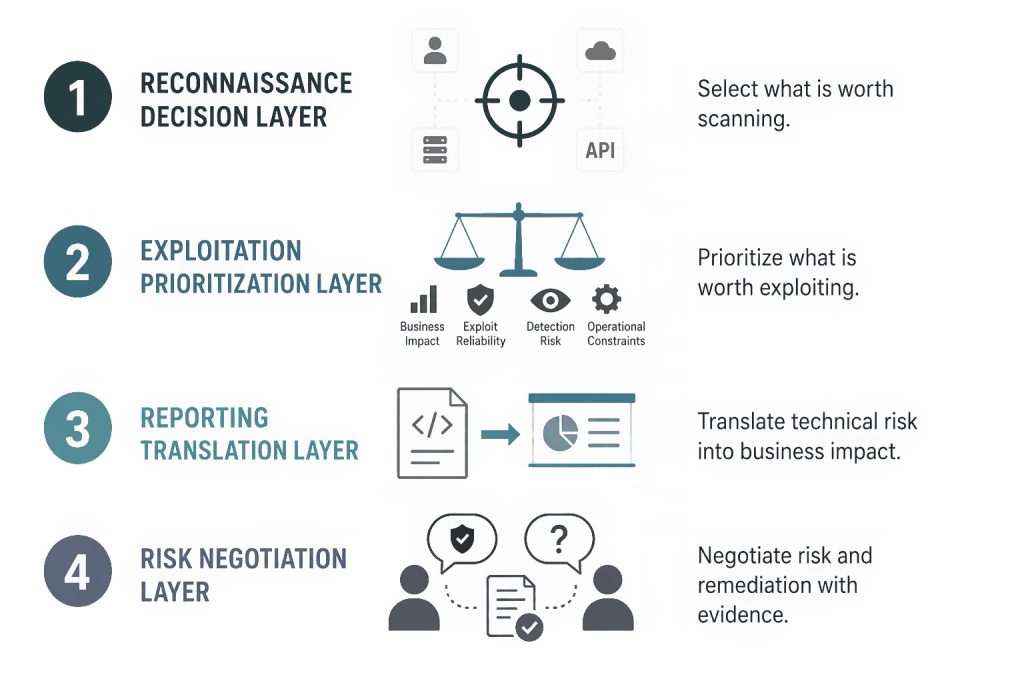
To understand what PT0-003 is actually testing, it helps to replace “tools” with something more accurate: decision layers.
1. Reconnaissance decision layer
This is not about scanning. It’s about selecting what is worth scanning.
In real enterprise environments, you could map an entire attack surface and still miss the critical path because identity systems or API gateways were ignored.
The decision is more important than the tool.
2. Exploitation prioritization layer
Not every vulnerability deserves exploitation. In fact, most don’t.
Modern penetration testers are increasingly expected to evaluate:
- Business impact
- Exploit reliability
- Detection risk
- Operational constraints
This is where technical skill meets judgment.
3. Reporting translation layer
A vulnerability report is not a log. It’s a narrative that connects technical risk to business consequence.
Many technically strong testers struggle here because they treat reporting as documentation rather than persuasion.
4. Risk negotiation layer
This is the layer rarely discussed.
In real engagements, findings are discussed with stakeholders who may challenge severity ratings, remediation timelines, or even the relevance of certain exploits.
Penetration testing becomes negotiation under evidence.
Where Traditional Tool-Based Study Breaks Down
There is a point where memorizing tools gives a false sense of readiness.
Knowing Nmap flags or Metasploit modules feels productive—until you are dropped into a scenario where:
- The network is partially abstracted through cloud services
- The asset inventory is incomplete
- Authentication is federated across identity providers
Suddenly, there is no “correct tool.”
Only competing strategies.
“Tools don’t fail in modern penetration testing. Decisions do.”
That’s the real gap PT0-003 exposes.
A Real Enterprise Reality Check
Consider two realistic scenarios often seen in modern assessments.
Hybrid cloud assessment scenario
A tester is given access to a hybrid environment spanning on-prem servers and a cloud platform.
Traditional thinking says: enumerate, scan, exploit.
But in reality, the critical exposure may lie in:
- Misconfigured IAM roles
- Over-permissive service accounts
- API trust relationships between environments
No single tool reveals the full story. Only layered reasoning does.
API-first architecture exposure example
In another engagement, the surface area is almost entirely API-driven.
A scanner identifies low-risk vulnerabilities everywhere—but the real risk lies in chained API calls that allow privilege escalation across services.
The tester who only “runs tools” walks away with a long list of minor findings.
The tester who understands system behavior identifies a critical business risk.
That difference defines modern penetration testing.
The Rise of AI-Augmented Penetration Testing
AI is already reshaping offensive security workflows.
Research into autonomous and AI-assisted penetration testing shows that many mechanical tasks—like enumeration and pattern recognition—are increasingly automated or semi-automated.
That doesn’t eliminate the penetration tester.
It changes their role.
From operator → decision architect.
When AI handles scanning and enumeration, the human becomes responsible for:
- Validating relevance
- Interpreting anomalies
- Prioritizing impact paths
- Making strategic decisions
PT0-003 reflects this transition more than most candidates realize.
Why Reporting Has Become a Core Skill
There’s a reason reporting appears so prominently in modern penetration testing frameworks.
Executives don’t fix vulnerabilities. They fix risk priorities.
A technically correct report that fails to communicate impact is operationally useless.
One of the most overlooked truths in the field is this:
“A vulnerability without context is just noise in a spreadsheet.”
This is why modern penetration testing increasingly rewards clarity over complexity.
The Hidden Skill PT0-003 Actually Measures
If you strip away the structure, the exam quietly evaluates one thing:
Can you make good decisions with incomplete information?
That’s it.
Not tool mastery.
Not memorization.
Not even raw technical depth in isolation.
Because real penetration testing environments are messy. Logs are incomplete. Time is limited. Scope changes mid-engagement. And stakeholders reinterpret priorities in real time.
The candidates who struggle are often those who expect clarity before action.
But modern security rarely offers that luxury.
What Experienced Testers Get Wrong
Interestingly, experienced professionals sometimes struggle more than beginners.
Why?
Because experience can harden assumptions.
They expect patterns to repeat. They expect environments to behave consistently. They expect tools to produce predictable outputs.
PT0-003 quietly breaks that expectation by introducing variability and scenario ambiguity.
It’s not testing whether you know what to do.
It’s testing whether you know what to do when what you expect is wrong.
What Candidates Should Actually Practice
The most effective preparation doesn’t look like exam prep at all.
It looks like exposure to uncertainty:
- Mixed cloud and on-prem labs
- API-driven environments
- Reporting exercises tied to business impact
- Scenario-based decision workflows
This is also where structured resources can help—not as answer sheets, but as guided environments for decision practice, such as scenario-driven labs and structured walkthroughs like those found in platforms aligned with PT0-003-style thinking (for example, 2026 Practice Resource, used here as one example of structured scenario reinforcement tools).
The key is not repetition. It’s variation.
The Future of Penetration Testing Certifications
If PT0-003 is a signal, it’s pointing in a clear direction.
Certifications are moving away from:
- Tool recall
- Command memorization
- Isolated exploit knowledge
Toward:
- System reasoning
- Risk interpretation
- Business-aligned communication
- AI-augmented workflows
In other words, the profession is converging toward something closer to cybersecurity analysis than traditional hacking.
And that shift is irreversible.
The Exam That Tests Thinking, Not Tools
PT0-003 doesn’t just measure penetration testing skill—it reflects how the profession itself is evolving under pressure from cloud complexity, automation, and AI acceleration.
The most important realization isn’t about the exam.
It’s about the job behind it.
Because modern penetration testing is no longer a sequence of tools chained together in a predictable order. It is a continuous cycle of judgment calls made under uncertainty, often faster than full information can be gathered.
Or perhaps the most honest way to say it is this:
“The best penetration testers are no longer defined by what they can run, but by what they choose not to run.”
And that is exactly the direction the industry is heading—whether certifications admit it explicitly or not.
![[High Quality Cisco Dumps] Best Cisco 100-105 Dumps PDF Training Resources And VCE Youtube Update Free Try](https://www.examscode.com/wp-content/themes/blogstream/img/thumb-medium.png)